

Thoughts from influential nature conservationists…
Jamie Buxton-Gould
What do you do/have you done in nature conservation?
I’ve been working in conservation for over 10 years: my craving to work outdoors in nature had its beginnings in volunteering with the National Trust, the Woodland Trust and the British Trust for Ornithology, leading to a role as a trainee Reserves Officer with the Wildlife Trust in Northamptonshire. I found a real passion for practical habitat management and monitoring wildlife, expanding these skills in my next role as Park Ranger at a Country Park in Leicestershire. Creating and managing valuable habitats including wildflower meadows led to the achievement of three Bees’ Needs Champions Awards.
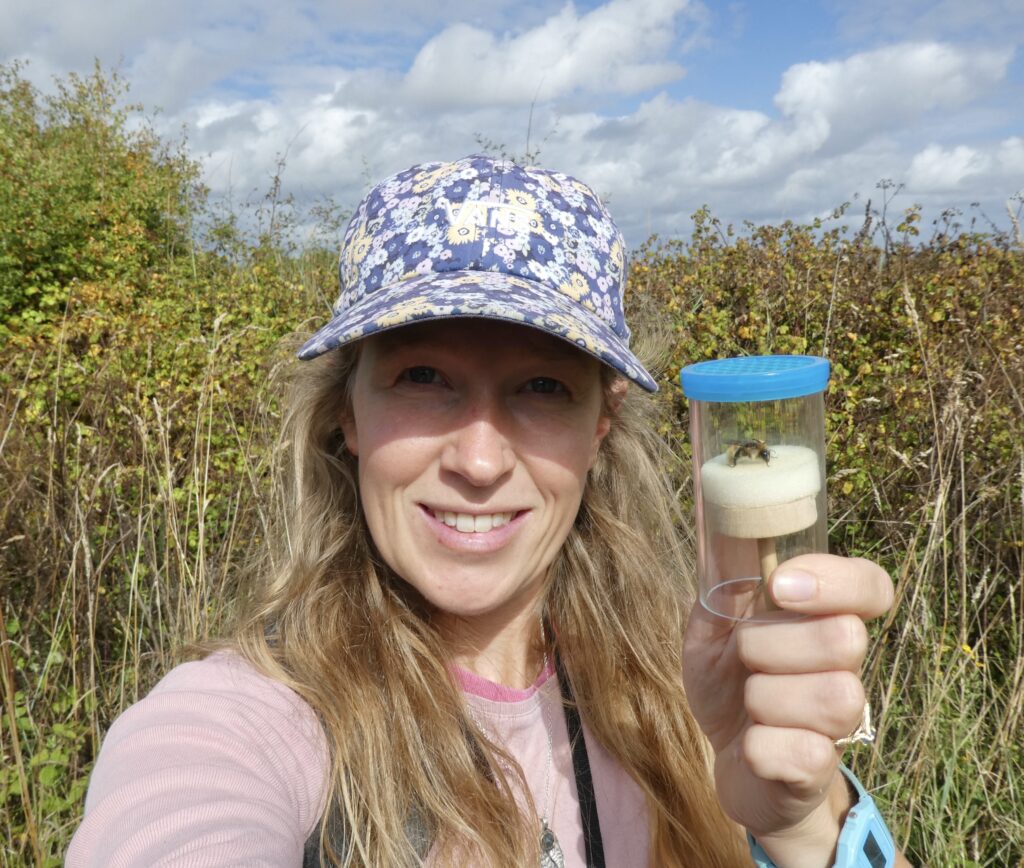
After moving to North Devon, I spent many days on Braunton Burrows as I studied plant species-richness and dung beetle abundance in response to grazing cattle for my MSc in Conservation and Biodiversity at the University of Exeter. With over 470 flowering plant species across that exceptional sand dune system, I enjoyed immersing myself in botany! Shortly after, as Conservation Officer for the Bumblebee Conservation Trust, I worked with a range of landowners to create and enhance wildflower-rich habitats across the coast. Habitat and bumblebee monitoring were highlights of the role, as were holding workshops teaching bee identification. More recently, I continued to deliver wildlife identification sessions for the North Devon Coast National Landscape and was lucky to work for a short time at Knepp as Assistant Ornithologist with Operation Wallacea, demonstrating bird ringing to volunteers.
Currently, I’m working as a freelance ecologist for landowners, nature-friendly farmers, wildlife groups and conservation charities. My work is varied, ranging from breeding bird surveys in spring, botanical surveys and habitat assessments in summer, to winter work that involves scrub control and halo thinning around old oak trees to give them room to breathe.
What have been two career highlights?
Accomplishing Local Nature Reserve designation for the Country Park I managed in Leicestershire was a proud achievement, along with seeing the abundance of butterflies and bumblebees increase in line with meadow restoration and creation. Along with a team of volunteers, I looked after a range of habitats across 67 acres. The park is much valued by the local community as a place to enjoy the countryside, experience changing seasons and encounter beautiful wildlife. Despite being on an urban-fringe, the total number of species currently recorded by many dedicated wildlife enthusiasts on site is 836!
Another highlight has been working on rare species recovery for a small but special creature – the brown-banded carder bee. Responding to targeted grassland restoration by landowners across the North Devon coast, this rare species expanded from its stronghold location to colonise a number of new sites. This gorgeous golden bumblebee also turned up at the nature-friendly farm where I now provide ecological services, after a number of years of us diligently sowing wildflower seeds, spreading green hay and using livestock to manage the grasslands appropriately. It’s an excellent demonstration of how working collaboratively at a landscape-scale can deliver results, given enough time.
The most influential person or event or book in your career…?
When I see the distinctive shape of a red kite overhead, I smile and thank one person: Roy Dennis. From 40 red kite pairs to over 4,400 today, Roy has also been responsible for reintroductions of many other incredible species, including white-tailed eagle and osprey. A spearheading figure in British conservation, I was fortunate to meet Roy on a rewilding course in Scotland a few years ago, after reading his fascinating book Restoring the Wild.
Roy had many pearls of wisdom for the group of younger conservationists he was addressing, telling us the changes he wants to see will be done by people like us. His positive outlook was inspirational, with his viewpoint that it was a good time to be in conservation, because the threats are so severe. He told us “It’s not a matter of if, but when!”, with a spark of determination in his eyes. Energetic and evidently passionate about conservation, Roy expressed impatience about people sitting around having endless discussions, saying we just need to get on and do things!
I particularly value the advice he gave me for engaging with landowners, as he reflected on how there has been a tremendous change in attitudes over the years. He discussed the importance of understanding historical baselines to help us plan for the future, emphasising the need to see the bigger picture. His broader perspective of looking to the continent to learn how certain species thrive, moves us beyond restrictive management prescriptions that can see struggling wildlife clinging on in sub-optimal habitats. A refreshed outlook can drive forward progress in nature recovery.
Among my favourite pieces of advice I received from Roy was that you could have five projects or ideas happening at once – if one is brilliant, three work and one fails, don’t worry about the failure; learn from it and move onto the next idea: “Never give in, never let anyone stop you, just keep going!”.
How do you define nature conservation?

“A thing is right when it tends to preserve the integrity, stability and beauty of the biotic community. It is wrong when it tends otherwise” wrote Aldo Leopold. I think this is a fitting definition!
Nature conservation is of utmost importance for every single species, including us. Conserving, restoring and creating nature-rich habitats is so often more to do with the management of humans than the wildlife itself. How do we find balance and restraint to allow nature to thrive in an overpopulated world? We must loosen our grip on some places and keep our hands on the land in others if we are to successfully coexist with nature.
I love the author and documentary maker Blindboy’s theory about how historically, mythology about nature would have kept us “in line with systems of biodiversity”. The idea that we would once have had a greater respect for nature, as stories and beliefs were interwoven with our existence. Fear and awe of nature would have been more widely ingrained in cultures with animist beliefs: the resplendent quetzal was so sacred to the Aztecs that killing one resulted in the punishment of death, and in Ireland in the 1600s, white butterflies were protected, as it was believed that they carried the souls of dead children. Holding the natural world in a state of reverence engenders preservation.
Conservation is one of the most difficult puzzles to solve, working out how we restore ecosystems with so many missing pieces. I struggle to comprehend how much we have lost, with the historic loss of megafauna causing cascading impacts on our ecosystems, through to present day challenges, like ash dieback suffocating our much-loved trees. It is an evolving practice, requiring multi-disciplinary skills from dedicated people, despite being a desperately underfunded industry. We can see the challenges of significant habitat loss faced by developing countries, yet as one of the world’s wealthiest nations, the UK lacks sufficient funding to conserve nature – if we can’t restore our degraded landscapes, how do we expect others to do so?
Conservation must also engage with people so they support nature recovery and understand the urgency of the situation. Research from Buglife has found flying insects have declined by 63% since 2021; can we encourage people to care, when far too often I hear questions like ‘what’s the point of wasps?’! Although there are a multitude of different elements that can come under the broad umbrella of conserving nature, I think terminology is important – if we want the wider public to be on board, using too many terms could become confusing, other terms such as rewilding can also be contentious in some circles. I find the practice of rewilding compelling and infinitely exciting, but realise that it could spark negative reactions when speaking to some landowners. Bridging these gaps is important, as we need to understand ways we can effectively and collaboratively value and conserve nature.
What’s the good news about wildlife and nature at present?

There are lots of good case studies! Both at home and further afield, I see the positive work of conservation organisations. I find that focusing on successful efforts in the environmental field help me to feel a little more hopeful.
I recently visited Madagascar, which was a bittersweet experience, as much of the island has suffered deforestation. The local guides are passionate about protecting precious remnants of forest, recognising their value for the endemic wildlife and for providing important jobs for the community. Looking into the eyes of a beautiful diademed sifaka (a large species of lemur) that appeared at the forest edge to forage for fruit was so special. I thought, here is a critically endangered animal right in front of me and we’re both co-existing right now together. It gave me hope about the possibilities of protected areas.
Closer to home, the issues of deforestation and habitat degradation are also ever present, but glimmers of hope are there. A few weeks ago I found an interesting log washed up on my local beach; examining it closely, I realised it had been felled by a beaver and was covered in tell-tale teethmarks. Its quite a thrill to think a formerly extinct species is close-by and thriving.
I also visited Lundy this Spring, and seeing the amount of puffins there really filled up my cup. There were only 5 puffins 20 years ago; now they number 1,800! Eradicating non-native rats from the island has enabled them to thrive. With enough dedication, the results speak for themselves. I stood on one of the most westward points of Lundy and held my breath as a pair of puffins landed and walked into their burrow just a few feet in front of me. Here was living proof of how we can reverse declines if we apply targeted solutions to problems.
Beyond the obvious of habitat loss and species decline, what’s your greatest concern in UK nature conservation at present?

One of my concerns is the lack of ecological literacy – a symptom of a growing disconnection with nature. My Gran would tell me how her father knew every bird and every plant, knowing their names and being able to meticulously draw each one. Plants are the foundation of our ecosystems, yet there is a startling lack of botanical ID skills.
In my previous role, I delivered some education and engagement activities with schools. I was saddened when the teachers told us that because of exams, the older age groups wouldn’t be able to participate in activities to immerse themselves in nature. Locked into the rigidity of a school system that places such high levels of stress at exam time is such a tragedy, as that is the exact time of year when the natural world is fizzing with life. The new Natural History GCSE offers potential, but experiencing nature free from the constraints of time and target grades is needed for deep appreciation to flourish. Access to nature for everyone is of course vital for this.
I do sometimes see gradual changes; I recently gave a talk to a local beekeeping group and was glad to see that there was increased recognition of the importance of our diverse native pollinators and the threats honeybees can pose through competition for floral resources. The more we can experience and learn about nature, the more we can cultivate understanding and custodianship for the countryside.
If you had a limited budget on nature conservation in Britain, what would you prioritise and why?
Properly funding nature-friendly, regenerative farming would be one of my top priorities. With 72% of the UK as agricultural land, farmers should be instrumental in contributing to nature conservation. Some of the farmers I work with strive to do everything they can to help nature, but there has been so much uncertainty and a lack of financial support that it is really difficult. I think we could achieve so much if there was targeted advice and support for every farmer, alongside financial incentives to encourage regenerative practices that conserve not only soil and water, but wildlife too.
North American farmer Gabe Brown, author of Dirt to Soil, describes regenerative farming as “Farming in synchrony with nature to repair, rebuild, restore and revitalise ecosystem function starting with all life in the soil and expanding to all life above the soil”. There are many excellent examples of regenerative farmers and it is encouraging to see some supermarkets becoming more committed to these practices. Farmers report financial gains and well as environmental ones, with positive outcomes extending to improved human nutrition. Producing food sustainably matters to every one of us, and some studies have shown that devoting up to 8% of farmland to wildlife habitats can significantly enhance yields.
How do you feel about your input to the subject – what if anything has it achieved and would you do it differently if starting again today?
I wish I had started my journey into conservation a little sooner, as I initially studied art and ceramics. I should really have taken more notice of my art direction, as all I could do was meticulously draw the birds from every page in my Complete Guide to British Birds Collins reference book!
I have felt proud to see plants I have sown by seed doing exactly what I hoped: viper’s bugloss unfurling electric blue blooms and attracting brown-banded carder bees. Even small, simple acts of collecting and sowing acorns and hazel seedlings to enhance the habitat around a greater horseshoe bat roost is immensely rewarding.
In my spare time I enjoy contributing to bird ringing projects, including the BTO’s Nest Record Scheme with my bird ringing trainer, Chris Dee. I’ve recently gained my permit to ring chicks of cavity nesting birds and I’m working with landowners to expand the network of woodland nest boxes that are vital for species such as pied flycatchers to thrive.
My impact may not be the biggest, but I have felt so privileged to have been working in conservation, helping wildlife where I could. Sometimes this has manifested in rather unorthodox actions, such as turning my allotment into a wildflower seed farm (much to the displeasure of the local council!), or sneaking with my scythe to guerilla-mow a neglected patch of wildflower-rich grassland.
I get quite a thrill from recording species (I’m at over 1,000 UK species on iNaturalist!). I found Devon’s first early colletes bee a few years ago, as well as a first record of a wasp spider and red bartsia bee for North Devon. Other exciting finds have included capturing pine martens on camera traps in new locations. Adding a dot to a map gives us a better picture of what species we have and what we could do to help.
There are so many things still to do and I wish I could do more.
Anything else you’d like to say…?

I hope our current generation of conservationists can continue to inspire and educate the next. I hope we can communicate the importance of those fine details of managing a habitat well for wildlife, so we can best help to protect it for the future. For example when managing a meadow it isn’t as simple as ‘no mow’, but more like; let it grow and time when you mow. I’m obsessed with taking photos wherever I go and of whatever I am doing in nature – you can see what I’ve been up to on my Instagram page: https://www.instagram.com/jbuxtongouldwildlife