

Pigs showing promise for wildlife conservation
Pollinators are desperately in need of assistance. With the loss of landscapes rich in flowers compounded by other threats, such as the prevalence of toxic pesticides, pollinators are struggling to perform their vital roles within the ecosystem. But help may be at hand from an unlikely hero: the pig.
Pigs are increasingly being used for conservation, helping to manage habitats and for kickstarting ecosystem function. Descendants of wild boar Sus scrofa, the domesticated pig Sus scrofa domesticus we might be familiar with today can seem far removed from their untamed ancestor. The potential the pig has for restoring ecological processes is rooted in their ancestral behaviour. Understanding the place they can have in our landscapes can enable us to revive struggling species from the foundations, bolstering populations of butterflies, flies, solitary bees and bumblebees.
The wilderness world of the wild boar – origins of pigs amongst a community of large animals

Pigs and wild boar are extremely closely related. Wild boar have been found in the fossil record from the early middle Pleistocene (from 2.5 million years ago) and continue to be well distributed across most of Europe today. During the previous interglacial period to the one we live in now, the Eemian (between 128,000 to 118,000 years ago), wild boar would have coexisted alongside some true giants. Straight-tusked elephants, aurochs, Irish elk (giant deer), cave lion, cave hyena, hippopotamus, rhinoceros and bison once formed a diverse megafaunal community in the UK1.
Foraging in a mosaic of grasslands, woodlands and wetlands, wild boar would have thrived in this varied environment, although they would have had to remain alert to the threats of predation from wolves, bears and cave lions. Their stripy camouflaged piglets blended into the bracken and leaf litter, staying close to their mothers for protection. Inquisitive robins and starlings would surely have followed them, opportunistically feeding on worms brought to the surface.
This safari-scape of immense animals would all have left their mark on the landscape. A 14 tonne straight-tusked elephant (twice as heavy as an African elephant!) would have certainly have made the earth move. Our megafauna suffered dramatic extinctions coinciding with the expansion of modern humans, and today it is estimated we have seen a decline of around 93% in their abundance. This has caused cascading impacts for ecosystems, as complex relationships unravel, habitats lose connectivity and ecological processes falter2. Communities of wildflowers and associated pollinators dependent on open habitats relied on these large animals to provide the conditions for them to thrive.

Favouring extensive wooded areas, smaller mammals such as the humble wild boar managed to survive alongside us to the present day, at least on the continent. Tracing the history of the wild boar in Britain reveals a story of overexploitation and habitat destruction; familiar themes to us today, but these pressures were also present hundreds of years ago. Reserved for royalty in the monarch’s forest, wild boar became increasingly scarce in the 13th century, resulting in their extinction in the 17th century. 200 wild boar and 400 pigs were served for Henry III’s great Christmas dinner in the year 1251, along with an obscene number of other wild creatures, including 1,300 hares, 395 swans and 115 cranes3. As well as demonstrating excessive indulgence, this also reveals the sheer abundance of wildlife in the landscape at that time.
Today, a small number of escapee wild boar are scattered throughout the UK, with the largest population in the Forest of Dean, Gloucestershire. The number of around 2,600 of these animals is dwarfed by up to 4.8 million pigs mostly reared indoors in intensive farming systems. Evidence of domesticated pigs dates stretches back to 9,000 years ago from the Middle East. These pigs frequently interbred with wild boar throughout Europe and some traditional pig breeds today hold a higher degree of ancestry to wild boars.
Some domestic pigs can be a perfect ecological proxy for a wild boar, carrying out the same essential ecosystem services, but with greater ease, not requiring a Dangerous Wild Animal licence necessary for wild boar. Mangalitza pigs are an ideal candidate: an old breed hailing from Hungary, closely related to wild boar. Traditional UK breeds such as Tamworth, Gloucester Old Spot and British Saddleback are also hardy and able to be outwintered at the time of year when most life is dormant, an optimal time for utilising their unique powers of habitat management.
Behaviour and ecology – wildflower gardeners

Watching a content pig in its element, as it is entirely focused on the ground beneath it is captivating. With an occasional satisfied munch, it effortlessly heaves a clod of earth and finds a tasty morsel beneath. Adaptable and intelligent, pigs omnivorous diet is varied, including plants, roots, fruit, fungi and invertebrates.
Prodigious earth movers, pigs create deep gouges in the turf as they rootle for food. Destruction for the purpose of creation can seem somewhat counterintuitive, but that bare earth provides a cascade of positive benefits throughout the ecosystem. Birds such as robins will follow in their footsteps, foraging for newly accessible invertebrates, ground nesting birds move in to open habitats, heat-seeking reptiles such as lizards can bask on warm earth and invasive bracken cover is pushed back, allowing more delicate plants to thrive. Today’s botanical communities evolved alongside the animals that were engineering the ecosystems and require a degree of disturbance. The incredible diversity that can be found in wildflower meadows stems from relationships that evolved before humans began to cut and gather hay for livestock. Large wild animals would once have managed grasslands before we did, and we must consider their impacts to fully understand the ecosystem dynamics at play2.

Both pigs and wild boar are demonstrating the benefits they can provide, with potential for more widespread use in wildflower-rich grassland conservation. A major service pigs can provide is bramble control. Not just through trampling or grazing as other animals might do, pigs get down deep into the soil to feast on bramble roots. No other conservation grazer could be so effective. Scrub encroachment from bramble is a major threat to vulnerable grassland communities, with conservation organisations investing a significant amount of time and resources to tackle it. Scrub is of course a valuable habitat in its own right, providing shelter, food and nesting opportunities for many species. There are many places where scrub should be growing but isn’t, and places where scrub begins to thrive at the expense of other valuable habitats. Finding the balance is key, with a varied mosaic forming the most wildlife-rich habitats. Pigs could provide the solutions needed to suppress invasive species and restore conditions for new life, with cascading effects through the ecosystem.

A recent study from Germany investigated the effects of wild boar on calcareous grassland communities and found that they were key at maintaining habitat complexity. Plots that had received boar rootling had significantly higher plant species richness, with higher coverage of herb species. Threatened plant species, such as betony, were found in areas group. receiving boar rootling. Undisturbed areas tended to be dominated by a few grass species, with fewer opportunities for wildflowers to germinate4.
Resetting succession is achieved, providing optimal early conditions for plant establishment, interrupting the relentless march of scrub and tree establishment. The positive impact of wild boar on plant species richness can even persist for years after the initial disturbance. Species benefitting from the creation of bare soil included broad-leaved thyme, perforate St. John’s wort, common bird’s-foot trefoil and hare’s-foot clover, with more than double the amount of plant species recorded in disturbed plots compared to non-disturbed plots in a study from the Czech Republic5. The process of germination can be fraught with difficulties for a tiny wildflower seed. Finding the perfect conditions with just enough light and not too much competition from neighbouring plants can be a challenge. A bare seedbed can lead to better success, with dominant grasses thinned out to make way for herbs that will produce all-important nectar and pollen in the growing season. Pollinators rely on plants, with some groups such as bees entirely dependent throughout all stages of their life cycle, with pollen consumed by the larvae and nectar being a vital energy source for adults. Pigs could even help in changing the fortunes of some of our rarest plants such as heath lobelia and water germander, both dependent on disturbance to thrive.
Pigs enhancing habitats for rare pollinators – from Knepp to North Devon

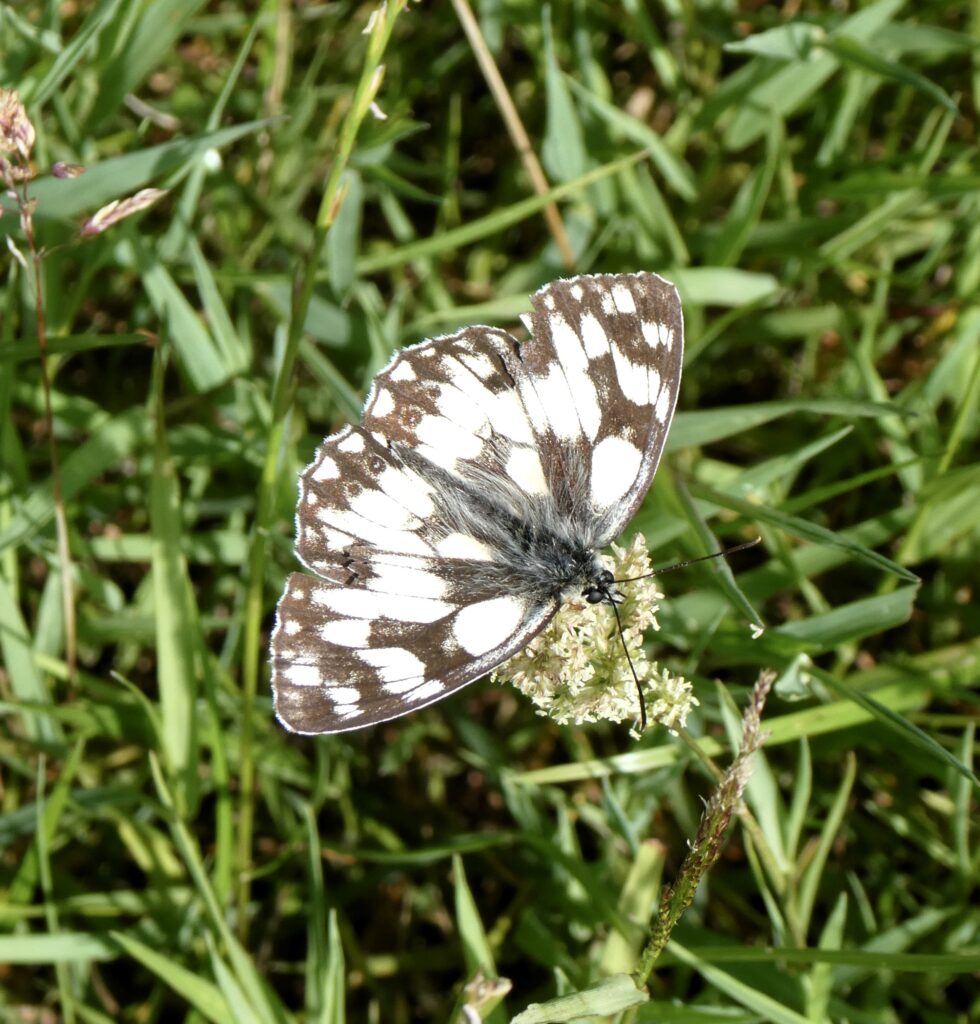
There are a number of examples of pollinators benefitting from pig activity, as this missing element has been slotted back into the landscape. On Nashenden Down, one of Kent Wildlife Trust’s nature reserves, fescue grasses are establishing in pig-rootled areas, providing marbled white butterflies with their preferred larval foodplant.
The Knepp Estate in West Sussex is well-known for transforming unproductive arable land into an innovative rewilding project. Cattle, horses, deer and pigs roam freely across 3,500 acres, shaping a range of habitats. As well as being instrumental in the management of the land, the livestock provide a supply of high-welfare, free range meat, alongside being a key draw for visitors, with wildlife safaris and workshops forming a major part of the Knepp business model.
Walking through Knepp, it is common to encounter areas of scraped earth where the Tamworth pigs have concentrated their rootling activities. Providing an ideal seedbed for ‘weeds’ such as scarlet pimpernel and chickweed, declining turtle doves have benefitted from this banquet of small seeds, finding a vital refuge at Knepp.

Other rare species have zoned in on these pig patches, finding ideal conditions to complete their lifecycles. The downland villa beefly Villa cingulata is classed as Nationally Rare, but is fortunately expanding its range, helped in part here by habitat creation from pigs. A few summers ago, I was conducting biodiversity surveys with Operation Wallacea at Knepp, led by entomologist Dr Erica McAlister, fly expert and curator at the Natural History Museum. Lying on her front with a beefly perched on her finger, her enthusiasm was infectious as she shared the secrets of this fascinating insect.
Coated in honey-coloured and black stripes, this bee lookalike is actually a parasitoid of moths, performing a fast-paced buzzing dance to gather sand grains. “She is collecting sand to coat her eggs to prevent desiccation once she has hurled it away to start its life away from her… this little gorgeous beefly is twerking her best life.” The eggs are flicked in the direction of the moth’s caterpillars to feast on their living bodies until it is ready to pupate to become an adult!
Caterpillars are an important link of the foodchain, and there are other places where pigs have been catalysing their vital role. For the past few years, the National Trust in Devon have used Mangalitza pigs on Exmoor’s Tattiscombe site. They found that in areas where the pigs had been most active, greater bird’s-foot trefoil germinated abundantly, attracting burnet moth caterpillars. In the summer of 2024, the National Trust captured intimate footage of a number of cuckoos hopping down to feed on the caterpillars. Able to produce hydrogen cyanide, burnet moth group caterpillars are toxic to most birds, however, cuckoos are specialists with processing poisonous caterpillars. Despite being preyed on by migratory cuckoos, there were still plenty of burnet moths taking to the wing over the moors that summer.

One landowner in North Devon was so inspired by the exciting work of the National Trust’s pigs that he bought three Mangalitzas of his own in 2022. Just four years on and the impact of the pigs is impressive, with rare bees now recovering on this part of the coastline thanks to their efforts.
Landowner Simon Maddocks shared his thoughts with me following summer surveys on his land in 2025. Formerly intensively horse-grazed pasture, the grassland plants never had a chance to flower, being continuously nibbled. Since the horses have moved on, four Belted Galloway cattle have taken over as grazers, with seasonal assistance from the Mangalitza pigs.
A patchwork of bare ground and wildflowers is testament to their efforts, as these hairy bulldozers have moulded the habitats around them. Some of the biggest impacts Simon has seen is preventing bracken encroachment by breaking rhizomes, destroying areas of dock and tearing up brambles by the roots. “If it were to stop, the bracken would come back, but where they’re damaging say 10% of the roots each winter, there’s 10% not coming back. It’s not to get rid of it, but to stop it taking over – so you’ve got a bit of everything and not too much of one thing.”
One of Simon’s favourite parts of the fields is a riot of colourful flowers, worthy of a Monet painting: “The beauty of it is that when they destroy stuff there’s a certain element of it that comes back, creating a mosaic; and on an area the pigs hit really hard, the flowers really did come back well.” That corner at the top of the hill overlooking Croyde bay drew me towards it with its abundance of species such as knapweed, smooth hawksbeard and bird’s-foot trefoil. Scarce bee species that are finding a haven here include the striking pantaloon bee Dasypoda hirtipes, the distinctive Black mining bee Andrena pilipes and theblack-headed mining bee Andrena nigriceps, with bare earth being essential for their nesting habitat.

The rare brown-banded carder bee Bombus humilis was formerly widespread across England and Wales, having suffered significant declines due to the loss of flower-rich grassland habitats. Finding refuge in a handful of locations, this charming golden bumblebee has started to recover in response to the creation of suitable habitat on the North Devon coast. Surveying the insect and plant life of Simon’s land, I was astounded by the amount of worker brown-banded carders I spotted busily going about their business. Compared to other places where they are found in the locality, it isn’t common to find so many individuals on a single site. Subtly distinct from common carder bees Bombus pascuorum by the absence of dark hairs on the abdomen, finding one after another of this special species was a fantastic feeling that things are headed in the right direction.
How does Simon feel about the rare bees colonising his land?: “It’s exciting, it’s the whole reason for me doing it originally – I got in contact with the Bumblebee Conservation Trust and that was my focus really.” I first met Simon whilst surveying for brown-banded carder bees during my time as a Conservation Officer and I remember scrutinising the first individuals we found to make extra sure we hadn’t mistaken their identities: “the first year – nothing, then a couple, then it just built up!” The carders were responding to an abundant food supply that hadn’t existed before. Reversing overgrazing combined with the presence of the pigs stimulated an array of wildflowers to bloom.
Discussing the plants the pigs have benefitted, Simon says: “I like them all, I hadn’t seen agrimony before and they’ve really helped the knapweed; I do like the knapweed because that’s a good one for the carder bees as a late feeder.” Requiring floral resources into September, this is a key flower for this special bumblebee.
Red bartsia is a hemi-parasitic plant that has also responded enthusiastically in the pig scrapes. Another rare species, the red bartsia bee Melitta tricincta, only obtains pollen from this flower and was also discovered here during the summer surveys. As well as requiring this key wildflower, the red bartsia bee needs open soil to be able to burrow into to create nest cells, where it will provision a precious egg with a ball of pollen for its development.
These exciting species discoveries are testament in part to perfect pig management. Simon is careful to ensure the pigs are put in a smaller enclosure in early spring until autumn to avoid potential disturbance to nesting bees and to allow plants to flower during the spring and summer. Half their year is spent roaming and rootling, whilst the other half is spent in their summer paddock, creating a balance of disturbed and undisturbed areas for a true mosaic of habitats. The pigs are now in demand for habitat management on nearby sites to spread their positive effects.
Future conservation uses of pigs – the power to drive forward rare species recovery?

Striding up the hill towards three pigs in the distance, I’m stopped in my tracks by an impressive patch of chocolate-brown soil a couple of metres across. This is exactly what I was hoping to see having let the Gloucester old spots into this parcel a few days ago, with the intention of reinvigorating the meadow habitat. I’m working with Emma Hydleman, a nature-friendly farmer to increase the diversity of wildflowers across her grasslands. A few days more and we can move them out to get the right balance of disturbance in the sward. Wildflowers can begin to expand into these bare areas, freed from the competition from nearby grasses. With brown-banded carder bees and rare long-horned bees Eucera longicornis found here on Middle Spreacombe farm for the first time in 2025, it is hoped we can further boost their numbers in North Devon.
It’s clear to see that the pigs belong on the land, just as their wild boar ancestors did. Although as they roll over so I can scratch their bellies, these friendly ladies are far from wild. Their docile natures make it more manageable to control and direct their habitat engineering compared to a wild relative, whilst providing the same results.
A number of places across the UK are using pigs for conservation grazing, including: Wild Ken Hill in Norfolk, Heal Somerset and Mapperton Wildland in Dorset. It’s even possible to rent out pigs for habitat management; a conservation grazing organisation called Cows in Clover has an offshoot called Pigs in Clover, that gives people the chance to hire out their pair of hardy pigs to help shape and improve habitats. Sharing and loaning of pigs can provide an ideal model for spreading their benefits most widely across a region. Encouraged by organisations such as the Rare Breeds Survival Trust, our traditional British pig breeds have scope to provide an important service in the countryside.
However, there are challenges associated with the use of pigs in this novel manner. Their powerful effects on the earth need to be carefully controlled, ensuring excessive disturbance is avoided at certain times of year, or in particular places. For example, not turning over a delicate meadow when plants are flowering in summer, or avoiding breaking the vital mycelial connections of a waxcap grassland. Pigs need space and stimulation, which can pose a problem for landowners without sufficient room, with a rough guide of two sows and their piglets supported by a single hectare7. As with other livestock, keeping within the carrying capacity of the land can be the difference between a rich mosaic of habitats and an overstocked, overgrazed plot with degrading soils. Rotation and resting the land are both important for pig management, as is supplying shelter and ample water for wallowing. Arguably one of the biggest challenges with pigs can be keeping them where they are supposed to be. Pigs are intelligent and inquisitive, easily escaping if not kept secure. Fencing enclosures with pig netting and barbed wire are effective, as is electric fencing, which has the benefit of being movable and allowing rotation around an area. Frequently checking and re-checking boundaries can involve quite an investment of time for a pig owner.

With clear environmental benefits, how can the use of pigs move beyond a small number of innovative and conservation-minded landowners? At present, in England, the new Sustainable Farming Incentive (SFI) application window opens from June, but beyond health, welfare and infrastructure grants, small-scale pig keepers may not be aware of, or be encouraged to consider using pigs for habitat restoration. An SFI option to manage priority habitat species-rich grassland provides funding for creation and restoration on suitable parcels. The application of pigs would go hand in hand with the initial bare ground required for seed sowing, providing plenty of germination opportunities. However long term, extensive bare ground is discouraged, meaning the role pigs could play would be temporary and sporadic, especially on smaller holdings. There is a lack of explicit options to encourage pigs for benefitting flower-rich habitats and a more creative approach would be needed to provide research and education underpinning these practices alongside much-needed financial incentives for farmers.
Cultivating a greater understanding of the pig’s potential could be key to supporting a variety of pollinators across the countryside, both common and rare. Their powers of ecosystem engineering provide an important early successional stage that has value across many habitats for a number of species. Some of the rarest species in the UK depend on these open conditions of early habitat stages. The collection of species detailed above, from Knepp to North Devon are just a few examples of those benefiting from the multitude of habitats created, from bare soil for nesting to an abundance of favoured foodplants forming the foundation of the food chain. Pig grazing could be a solution for other threatened species: focusing their efforts on and around locations with disturbance-dependent species in need of habitat restoration could be a way to make their presence most impactful and experiment with nature recovery at scale.
Whilst the winter rootling of pigs can look destructive, it is important to keep a vision of summer in mind. Picture the plants and insects that will follow in their footsteps when the cycle begins again. Complex relationships playing out as species live their lives in synchrony with large animals just as they have done for millions of years.
References
1. Kurtén, B. (2007) Pleistocene Mammals of Europe. Aldine Transaction: London
2. Søndergaard, S.A., Fløjgaard, C., Ejrnæs, R. and Svenning, J. (2025), Shifting baselines and the forgotten giants: integrating megafauna into plant community ecology. Oikos, 2025: e11134. https://doi.org/10.1111/oik.11134
3. Rackham, O. (2000) The History of the Countryside. Phoenix: London.
4. van Leeuwen, B. O., Tuinder, Q., Fartmann, T., Scherer, G., Klamm, A., Schellenberg, M., Vergeer, P., Jansen, P. A. (2025) Effects of wild boar (Sus scrofa) rooting on abandoned calcareous grassland in Hainich National Park, Germany. Global Ecology and Conservation 59:e03535 www.sciencedirect.com/science/article/pii/S2351989425001362
5. Horčičková E, Brůna J, Vojta J. (2019) Wild boar (Sus scrofa) increases species diversity of semidry grassland: Field experiment with simulated soil disturbances. Ecol Evol. 2019;9:2765–2774. 10.1002/ece3.4950
6. Falk, S. (2015) Field Guide to the Bees of Great Britain and Ireland. Bloomsbury: London.
7. Soil Association (2008) Pig Ignorant? A Soil Association guide to small scale pig keeping: https://communitysupportedagriculture.org.uk/wp-content/uploads/2015/03/Pig-Ignorant-guide-to-small-scale-pig-keeping.pdf