

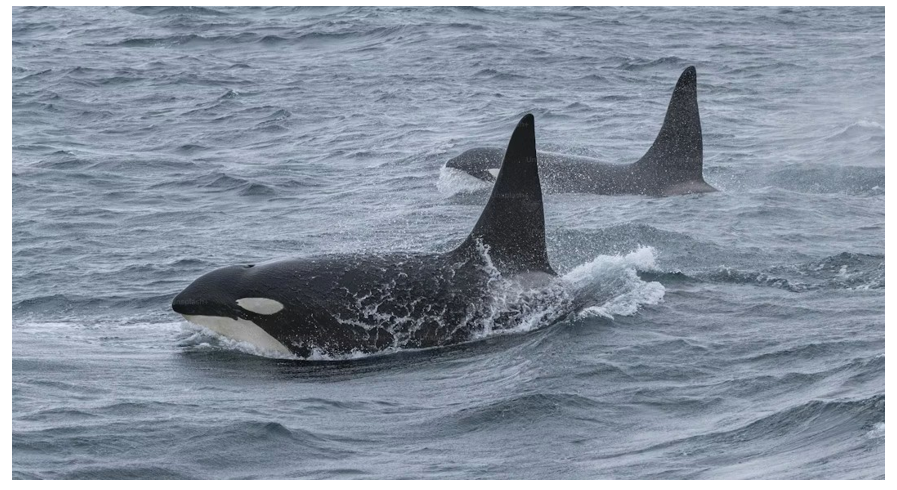
What Iberian orcas can teach conservation about public narrative
NIK MCEWAN
Since 2020, Iberian orca-vessel interactions have become one of Europe’s most recognisable wildlife stories. Boats have been damaged. Crews have been frightened. Advice has shifted. Speculation has multiplied. The case now travels far beyond the waters in which it first drew attention. Plenty of people who know little else about this population know the boat story.
Popular coverage has been extensive. See, for example: ‘Why Has a Group of Orcas Suddenly Started Attacking Boats?’ (Scientific American, 2023); ‘Orcas sank a yacht off Spain — the latest in a slew of such “attacks”’ (NPR, 2023); ‘We completely freaked out: Orcas are attacking boats in Europe again’ (Live Science, 2025); and the ongoing media analysis in Villarroel Villamor et al. 2025 (see Further reading), which examined 107 Spanish news articles from 2022–2024 and found that 38% of sailors described their encounters using the word “attack”.
Most discussion still circles the same practical questions. What are the whales doing? Why are they doing it? What should mariners do if contact begins? Fair enough. Those questions matter. But they are not the only ones that matter. The other question is what happens when a small, vulnerable population becomes publicly known mainly through conflict.
Conservation is never only about biology. It is also about framing. Most people do not first meet a species through a demographic paper, a workshop report or a technical review. They meet it through a story. The story decides what feels central, what gets repeated, what gets remembered, and what the animal comes to stand for. Once a species enters public life through a dramatic conflict narrative, the narrative starts shaping what people think the conservation issue actually is.
In the Iberian case, the trouble is not simply drama. It is narrowing. A conservation-sensitive population has become widely legible through vessel damage, fear, motive-heavy retelling and a running sense of confrontation between humans and animals. Once that becomes the dominant lens, everything else loses ground.
Anyone who has watched conservation arguments in Britain for long enough will recognise the pattern. The species changes. The politics change. The landscape changes. The pattern does not. An animal enters public debate through conflict, grievance, symbolism or fear. Before long it is carrying more cultural meaning than ecological context. People stop talking about a population in a difficult setting and start talking about a public character in a moral argument.
The Iberian orca case is not just an Iberian story. It is a sharp example of something conservation repeatedly struggles with. Once conflict becomes the frame, the frame begins generating its own reality.
The weight of charisma
Orcas are especially vulnerable to this because they arrive in public culture already weighted with meaning. People do not read them as neutral animals. They are read as intelligent, wilful, social, emotionally legible, almost theatrical. Some of that comes from serious research. Some of it comes from documentaries, popular culture and the ordinary human habit of turning charismatic wildlife into something uncomfortably close to a person. Whatever its source, the effect is the same. When dramatic incidents occur, interpretation hardens quickly, and motive becomes the first stopping point.
The whales become aggressors, saboteurs, rebels, symbols of nature pushing back, or something else equally satisfying to human imagination. In one register they are malicious. In another they are avengers. In a softer version they become emblems of wild intelligence that we are simply too crude to understand. The tone changes. The structure does not. The animals are made to carry human narrative needs.
That is bad for conservation because it alters the scale of the whole case. A small population can end up carrying a symbolic burden far larger than its ecological reality. It becomes famous, but in the wrong register. Public familiarity grows while public proportion shrinks. The animals are discussed constantly, yet what is being discussed is often a sharpened cultural version of them rather than the harder, less satisfying conservation reality.
Why conflict travels
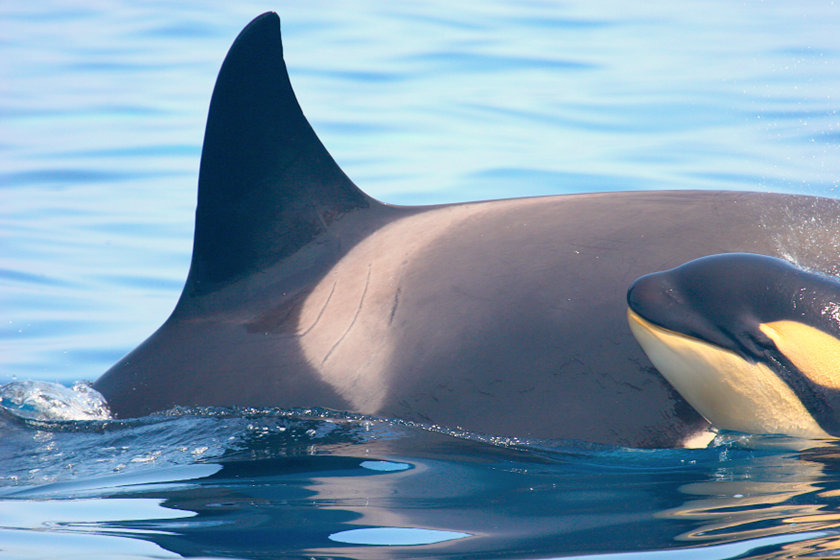
Photo: Renaud de Stéphanis
The Iberian orca story shows why. Conflict is narratively efficient. It gives a story shape immediately. Someone is at risk. Something unusual is happening. The scene is vivid. The emotional cues are obvious. There is room for fear, judgement, motive and endless reinterpretation. Stories like this travel because they ask very little of the audience. People already know how to enter them.
What travels well, though, is not always what serves conservation well. Conflict framing pulls attention towards the encounter itself and away from the wider conditions around it. Public discussion starts orbiting around damage, blame, fear, motive and spectacle. Population vulnerability, ecological pressure, uncertainty, management difficulty and plain proportion get pushed aside. Once that happens, everyone speaking about the species is working inside terms they did not set. Researchers correct overstatement. Institutions issue guidance around it. Communicators qualify it. Campaigners push back against the caricature. Journalists package it. Conservation is no longer setting the terms. It is firefighting inside a story that is already out in the world doing its own work.
A familiar pattern
Britain has seen plenty of versions of this. Different animals, different arguments, same basic trap. A species becomes a proxy for wider anxieties. It starts carrying disputes that were never properly its own. It becomes easier to use than to understand. Beavers become arguments about flooding and land control. Badgers become arguments about disease and culling. Gulls and raptors become arguments about nuisance, predation and who gets to decide what belongs where. Iberian orcas are not any of those species, but the structural problem is much the same. Conflict can become the whole story long before conservation has any chance to put context back in.
Holding two truths
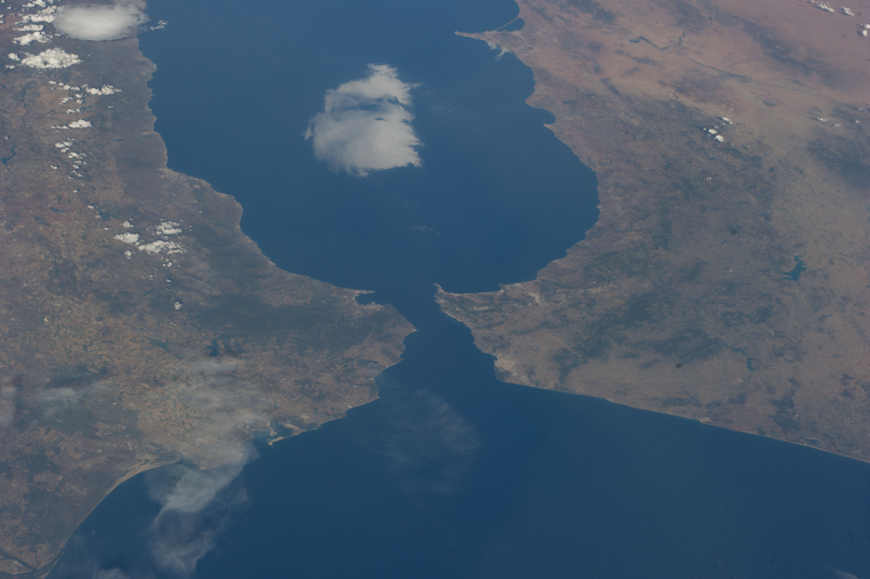
Photo: NASA
None of this means the incidents should be minimised. That would be another distortion. Real damage has occurred. Practical guidance matters. Risk at sea is not melodrama, and conservation does itself no favours if it slides into evasive language whenever human danger enters the frame. Mariners are entitled to seriousness. The issue is not that the story is false. The issue is that it is incomplete, and that incompleteness is not harmless.
The hard part is holding two truths at once. The encounters matter. They are operationally serious, they have altered behaviour at sea, and they demand guidance and attention. They are also not the whole meaning of the population involved. If the public comes to know Iberian orcas mainly as the whales from the boat story, then conservation has already lost ground, however much attention the case is receiving.
This is not just a matter of tone. Public narrative alters what starts to seem reasonable. Once a species is strongly associated with conflict, calls for control, deterrence, blame or symbolic judgement become easier to sustain. The moral terrain shifts first. A species encountered mainly through conflict becomes easier to argue with than to think about.
Charisma complicates all of this. It is an asset, obviously. Charismatic species attract care, fascination and engagement. Sometimes that is indispensable. But charisma also invites projection and over-reading. The more symbolically charged the species, the more discipline is needed in how it is discussed. Otherwise, charisma stops being a bridge to understanding and becomes a licence for distortion.
Charisma lowers the threshold for over-interpretation. With less symbolically charged species, people are more likely to describe what happened and stop there. With orcas, description rarely stays descriptive for long. The animal arrives already half-translated into human terms. Intelligence becomes intention. Sociality becomes strategy. Repetition becomes purpose. That does not make the public response irrational. It makes it predictable. And because it is predictable, conservation has to be more disciplined, not less, when speaking about charismatic animals under conflict conditions.
The quickest trap is premature moralisation. Wildlife behaviour does not become clearer because it is pushed into human roles. The move from incident to character is one of the fastest ways to lose analytical balance. Conservation should be most wary at the point where public language starts assigning animals the kinds of motives that make a conflict story feel settled before understanding exists.
There is a second trap as well: symbolic overuse. Not every striking wildlife case needs to be turned into a parable about human guilt, ecological revenge, modern alienation or nature striking back. Those story forms are powerful. They are not neutral. They flatten what is specific. They encourage audiences to consume wildlife as meaning rather than understand it as conservation reality.
Attention alone is no real measure of success. A species may be everywhere in public conversation and still be held badly in public thought. Fame is not support. Recognition is not ecological clarity. What matters is not simply whether people have heard of the species, but what exactly they think they have heard.
That may be the most uncomfortable lesson in the Iberian case. Conservation is never outside storytelling. It needs stories to mobilise care, legitimacy and concern. But the same habits that make conservation persuasive can also make it careless. It can become too willing to live with a story that works, even when that story narrows the thing it is supposed to protect.
The deeper problem here is not just exaggeration. It is substitution. A vulnerable population starts being replaced, in public consciousness, by a conflict narrative that is easier to grasp and easier to circulate. The animals are still there, of course, but they are now surrounded by layers of public meaning that shape every later conversation. Recovering proportion after that is hard. Recovering ecology is harder. Recovering the population itself, as the real object of concern, is harder still.
The case matters beyond the region because it shows how quickly a species story can harden around conflict, how easily a charismatic animal can become a public character, and how much work is then required just to put scale, uncertainty and vulnerability back near the centre. The particulars may be Iberian. The conservation lesson is not. A species can become a story before it becomes understood. Once that happens, conservation has a harder task than simply supplying better facts. It has to recover proportion. It has to keep the population itself in view. And it has to refuse the invitation to let conflict become the whole story.
Further reading
Díaz López, B. and Methion, S. 2024. Killer whales habitat suitability in the Iberian Peninsula and the Gulf of Biscay: implications for conservation. Ocean and Coastal Management 255: 107245.
Esteban, R. et al. 2025. Demographic parameters of Iberian killer whales between 2011 and 2023. Marine Mammal Science 42: e70088.
Villarroel Villamor, J. D., Vitorino de Medeiros, J. A. and Antón Baranda, A. 2025. Media narratives of human-wildlife conflict: Iberian orcas and boats in the Spanish press. Conservation 5(4): 54.
Popular media examples referenced in the text: ‘Why Has a Group of Orcas Suddenly Started Attacking Boats?’ Scientific American, 18 May 2023; ‘Orcas sank a yacht off Spain — the latest in a slew of such “attacks”’ NPR, 13 June 2023; ‘We completely freaked out: Orcas are attacking boats in Europe again’ Live Science, 3 September 2025.
Nik McEwan is a writer and conservation commentator with a particular interest in how wildlife stories are framed in public debate. His recent work examines Iberian orca-vessel interactions, conservation evidence, and the way conflict narratives shape public understanding of vulnerable species.