

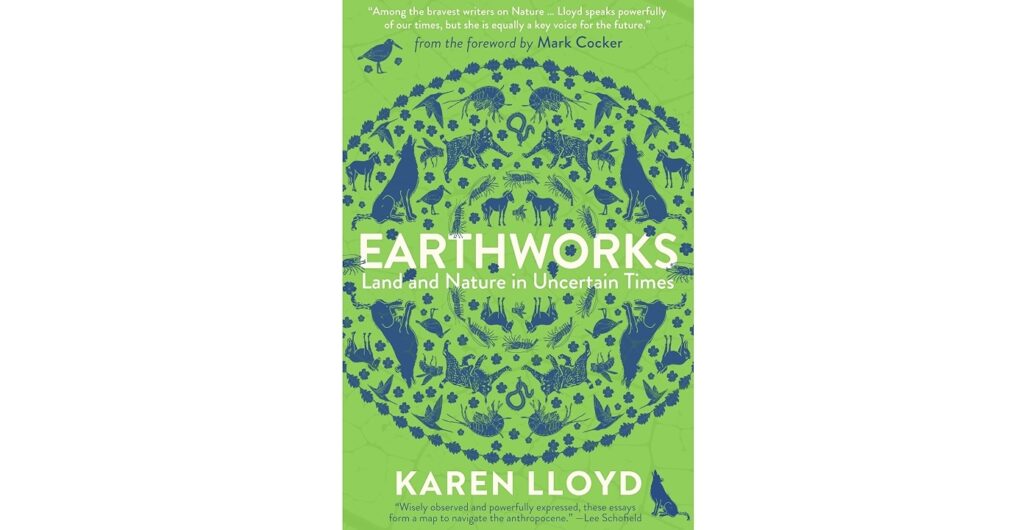
Land and Nature in Uncertain Times
Karen Lloyd
Saraband, 2026, 242 pages
Paperback £12.99 | ISBN 9781916812642
Review by Barry Larking
This is an easy book to read. In fact it is difficult to put down. Karen Lloyd is above all a compelling storyteller. In a series of essays she covers engaging case studies on different environmental topics from diverse locations.
The range of experiences Lloyd tackles in Earthworks is a large one. Sloths in Costa Rica, ancient horses with a nearly unpronounceable name and an alarming sounding chapter to themselves (Shooting Horses with the Hungarians turns out not quite as feared, thankfully), and a Dutch cyclist’s encounter with a wolf under the street lights. We then double back to the attractions of Morecambe recalled from childhood (with a nice twist; her origins are thereabouts), a Morecambe that shaped but doesn’t confine Lloyd’s fascination with the natural world and its discontents.
Some – not all – nature cum environment writers go in for ‘literature’ far too obviously. The best – and there are a few – write well without making you think they have misspent their youth reading the Thesaurus. Words few use in everyday conversation do not entrance this reader, that is grateful to have been spared. Lloyd is almost jocular in contrast – her chapter titles include: The Bear the Taxi Driver and the Custard Cream. Hands up everyone who wished they had written that? However, the subtitle reminds us that the subject of the natural world as it presents to us today is no joke; Inside the Rock Pool Shrimp There Is a Dying Star – about microplastics – gives one the troubling thought that once use plastics (wrappers etc., etc.) is a much more certain Karma for the human race perhaps even than The Bomb.
The current confounding state of Nature: What to do? Honestly:
“Through my preoccupations with bewilderment, then, I take a series of meandering journey’s which, place by place, species by species, experience by experience, are an orientation towards restoration and recovery …. For me there is a compulsion to do this… I cannot do other than locate something of the messy, unforgiving, over looked and bewildering brilliance that resides yet at the heart of the world, much in the way that clarity arises from the play of light and shadow in the aftermath of rain.”
Writing this good needs to be read. As Mark Cocker writes in his Introduction “At its heart the essay… is a quest to understand both whatwe think of the world, but also, and crucially, why we think and feel as we do”. The great and good essayists have this gift of turning almost any material into confiding and inclusive, lasting prose to make readers think. Karen Lloyd is one such and we should be grateful.