

Conservation in art, museums and archives from medieval Persia to modern rural England and beyond
JANET MACKINNON
The Shock of the New was a 1980 television series presented by Australian critic Robert Hughes exploring modern art movements and how these ruffled contemporary feathers, as did Hughes himself. By contrast, the recent London and Thames Valley installations reviewed below tend to engage and challenge on a more subtle, but still powerful, level. However, we undoubtedly live in a cultural milieu wrestling with ‘The Shocks of the Now.’ These are real world challenges – but also opportunities – presented by an increasingly digitalised world dominated by international big tech and new money, as well as a growing consciousness of nature and the more than human’s importance for the future of humanity.
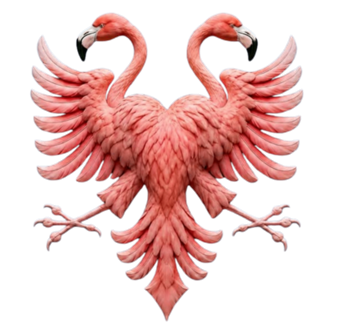
A manifestation of such consciousness emerging from the conservation diaspora is what has become known as Albania’s ‘Flamingo Revolution,’ a national (and indeed international) mobilisation against plans by Donald Trump’s daughter and son-in-law to develop a luxury resort in one of the Balkans’ most significant nature reserves. The movement’s logo is the double-headed flamingo shown above, a clever subversion of the Albanian double-headed eagle and symbol of state power.1 In contrast to a Trump deal-making dynasty and perceived government-facilitated corruption, Flamingo Revolution describes itself as ‘a civic movement dedicated to protecting nature, defending citizens’ rights, and building a fair, transparent and liveable Albania for everyone.’ As one commentator has put it: “The Flamingo Revolution demonstrates how environmental activism can evolve into a broader movement for democratic participation and public accountability…The flamingo has become more than a bird.” 2
Bird symbolism has a long history of provoking debate about important contemporary issues, and it is noteworthy that Crimean Tatars also subverted the image of a double-headed eagle, this time belonging to the Russian Federation, in protest at the annexation of their Ukrainian homeland.3 The use of birds to explore social and spiritual matters has particularly strong provenance in the Islamic world as reflected in the first subject of this review, the Canticle of the Birds exhibition at London’s Agha Khan Centre earlier in the year. Another exhibition, this time at the Museum of English Rural Life in Reading, explored ‘Radical Rural’ movements in England that also resonate with concerns about conserving rurality, including landscapes and ways of managing these, across Europe and beyond in the face of economic pressures and technological change. The relationship between conservation and technology is an increasingly complicated one but encountered positively in the international Biodiversity Heritage Library, an online US-led project involving major partners from across the globe. This review’s final destination is the Wild Table of Love installation next to London Paddington Station which gives human observers places among a group of endangered iconic animals from around the Earth, prompting reflection on rewilding and the natural world.
Canticle of the Birds, Agha Khan Centre, Kings Cross, London
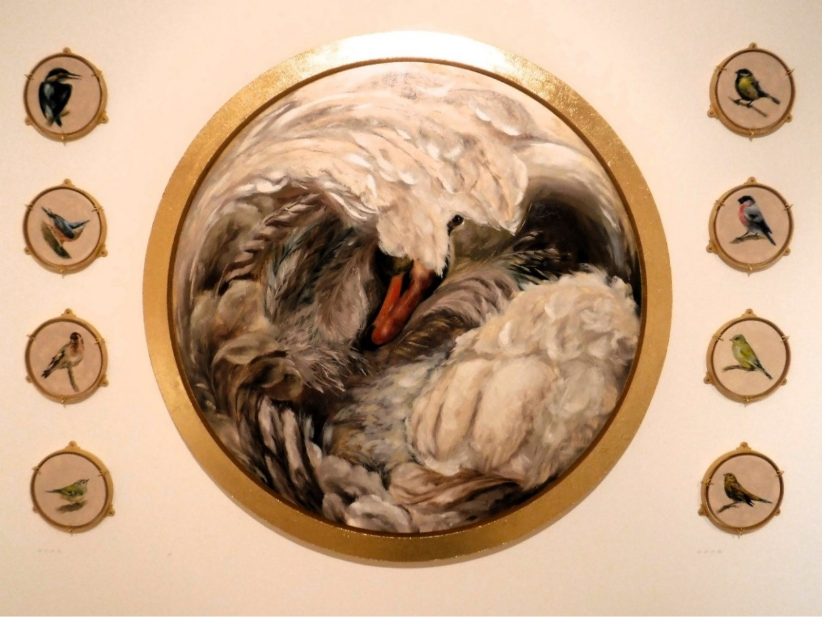
When I visited this fabulous exhibition at the beginning of March, war had just broken out between a United States-Israeli alliance and Iran, together with its regional partners. My contributions to ECOS had also unexpectedly begun over a decade earlier with an article on Iranian nature conservation at a time when the country’s then (briefly) more liberal and reformist secular leadership had recently embarked upon much needed environmental sustainability programmes.4 Unfortunately, it was not long before the deep state religious and military regime re-asserted itself, inflicting an ongoing national tragedy compounded by recent conflict. Nevertheless, in this grimly hostile environment it is testimony to the wider importance of nature to Iranian heritage that conservationists are still at work. Again, the flamingo has proved to be a symbol of renewal for those facing extremely challenging times, with the international news site Mongabay reporting on the inspiring resilience of NGO AvayeBoom Bird Conservation Society.5 Indeed, it is a rather sad irony that, as in Ukraine, the impact of war has not been entirely negative for nature, with AvayeBoom reporting higher than usual numbers of Greater Flamingos at Southern Iran’s pink Maharloo Lake, perhaps due to reduced water extraction from agriculture and industry in the latest attritional conflict.
Canticle of the Birds encourages ongoing reflection on the meaning of environmental stewardship in a ‘connected world’, to draw upon the title of the 2026 UCL Nature and Conservation Society and the reason for my visit to London.6 The Agha Khan Centre is only a short distance from London Wildlife Trust’s Camley Street Natural Park, a small nature reserve created in 1984 from an urban conservation movement which gathered momentum during that decade – as recounted in ECOS at the time – and has since flourished. The exhibition was organised in partnership with the UK-based SongBird Survival charity, whose mission is to conserve populations of song and other small birds for national biodiversity and the public through evidence-based research. ‘Canticle’ means a ‘small song’ with Christian religious connotations in Latin, but Canticle of the Birds drew its main inspiration from a famous Persian medieval poem, The Conference of the Birds.7 Written by Attar of Nishapur in what is now modern Iran, this narrative integrates allegorical tales from Sufi Islam as the birds embark upon a spiritual quest to find their guardian, the enduring mythical avian Simurgh, again reminding me of the symbolic double-headed flamingo.8
Radical Rural, Museum of English Rural Life, Reading
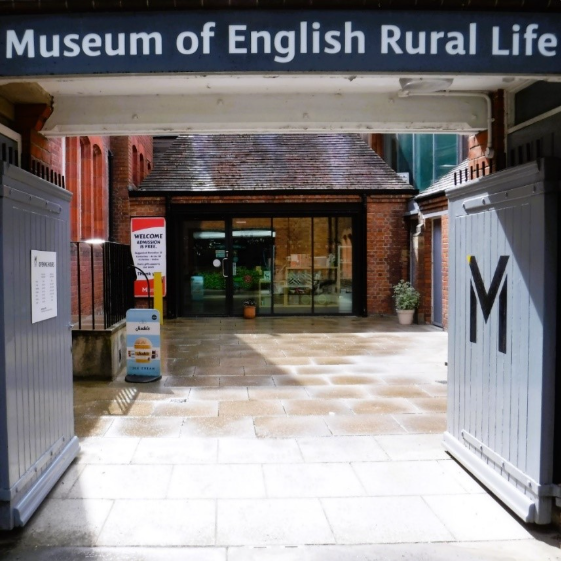
Although very different, Reading’s Museum of English Rural Life shares with London’s Agha Khan Centre a welcoming spirit, and the recent Radical Rural exhibition was equally stimulating and engaging.9 MERL, as it is known, was founded in 1951, emerging from the University of Reading’s long connection with agriculture and the aim of recording the changing face of farming and the countryside in post-World War II England. Connections to the more urban Festival of Britain of the same year are explored in a permanent exhibition and the museum has an important library and archive. An image from this collection became the unlikely subject of a Twitter (before this became X) feud in 2019 when later owner of the platform Elon Musk borrowed one of its images for his profile picture. The image in question was a 1962 photograph of an Exmoor Horn ram originally shared by Museums Partnership Reading to draw attention to MERL’s digitalised collection. Musk seems to have embraced this as a symbol of his masculinity with puns shared at the time in retrospect also anticipating so-called RAMageddon’, a global computer memory supply shortage linked to data centres for generative artificial intelligence.10
Transformative technologies was one of the themes encountered in Radical Rural’s programme of events based around a physical exhibition which took place between February and May this year. Another topic was countryside access, a controversial issue with a long disputatious history which has been explored in recent ECOS contributions anxious about potential negative impacts. However, it is worth emphasising that Radical Rural was also planned to coincide with the Campaign to Protect Rural England’s centenary and publication of a book – Future Rural: Imagining Tomorrow’s Countryside – to celebrate CPRE’s work.11 This has largely focussed at the national and local levels on regulation of land use through the spatial planning system and latterly the Land Use Framework for England on which the organisation has produced a very helpful critique.12 Along with public access, the wider future of the countryside remains deeply contested and it is worth considering CPRE’s vision alongside other rural manifestos, such as that of Future Countryside which has links to the hunting movement.13 Notwithstanding these differences, there is still a degree of positive coalescence around certain key issues, including the need to restrict large-scale development and infrastructure, as neatly embodied in the name of one local alliance: Lincolnshire Against Needless Destruction/‘LAND’.14
Biodiversity Heritage Library, US institution-led global online project
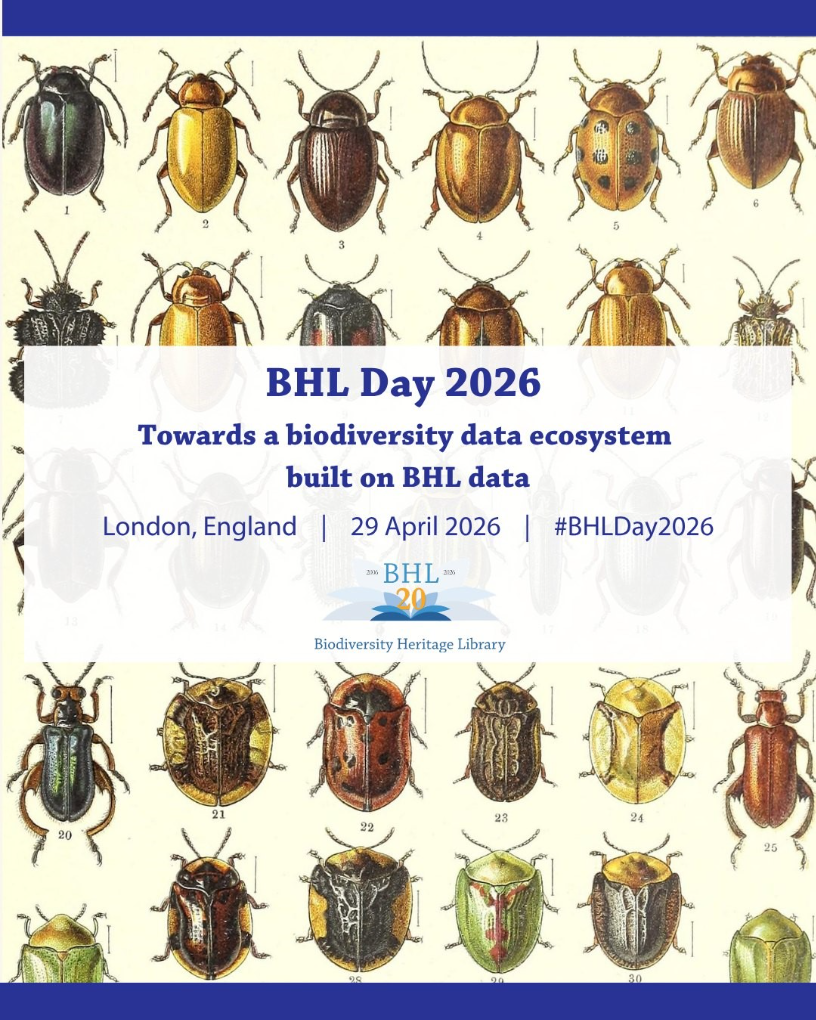
I have been interested in the potential roles of archives in nature and rural conservation since encountering the excellent Worcester Library and History Centre, later part of the city’s Hive Library, during the early 2000s. Moreover, it was at a meeting about West Midlands cultural resources in the same era that I unexpectedly met the late Dame Stella Rimington, formerly Director General of MI5, who had started her professional life in the Worcestershire Record Office. Ever since then, archives have held a certain potency for me, not least in their ability to greatly contribute to our understanding of natural heritage and historic environments, as reflected in the inspiring legacy of historical ecologist and landscape historian Oliver Rackham.15 The Biodiversity Heritage Library was formally established in 2006 by 10 founding organisations, mainly US but including London’s Natural History Museum and Royal Botanic Gardens Kew with the Washington-based Smithsonian Institution hosting the enterprise until 2025 when the Field Museum in Chicago took over this role.16 BHL now operates as a global consortium with over 80 partners and some 660 contributing organisations to create the world’s largest open access digital library for biodiversity literature and archives from the 15th-21st centuries.
Like many non-digital natives, I have never experienced unqualified enthusiasm for new information technologies or ubiquitous digitalisation. My reservations have grown as the environmental impacts of these become clearer and look set to expand with the advent of generative artificial intelligence, and its multiple other challenges (as well as opportunities). In 2025-6, BHL reported problems with Grok – there is now a Grokipedia – the AI chat box developed by Elon Musk’s SpaceXAI, and other bots linked Large Language Model robot crawlers causing some disruption to services. The response has been to use Cloudflare gatekeeper technology to reduce unwanted bots and implement the increasingly ubiquitous “are you human?” checkbox. On the positive side, since 2024 BHL has used Amazon Web Services as part of an AWS Open Data Sponsorship Program enabling a full transition to cloud technology. BHL is described as the ‘most comprehensive library of life on earth ever assembled’ and ‘building a resilient, modern technical foundation is central’ to its ‘next chapter’.17
Wild Table of Love, next to Paddington Station, London
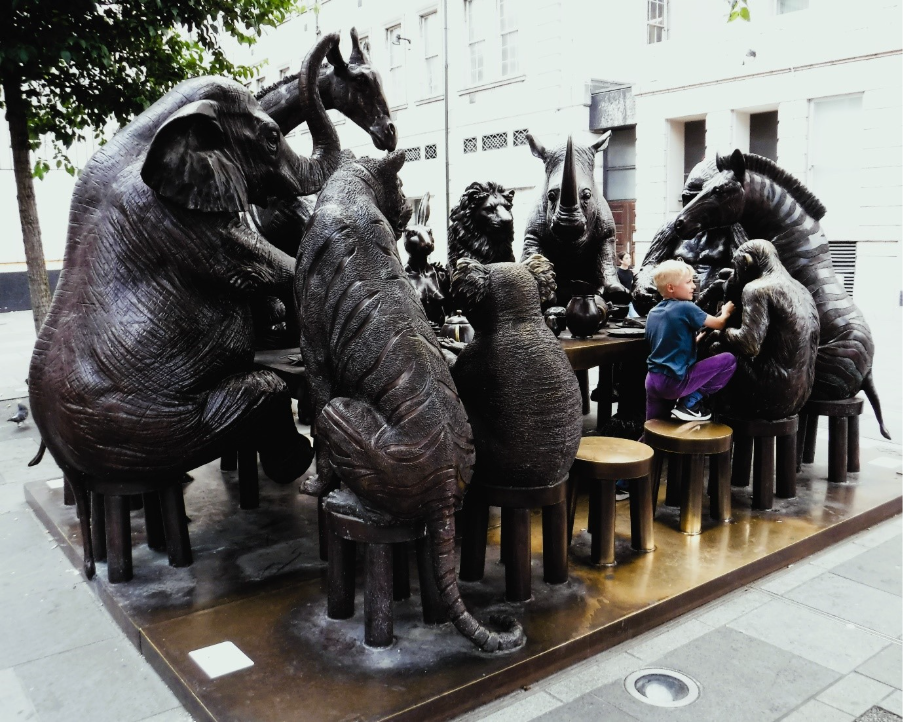
The next stop on my exploration of ‘the shocks of the now’ (and indeed ‘the new’) is the Wild Table of Love installation outside London’s Paddington Station.18 I chanced upon this rather lovely animal gathering, with two empty seats for humans, in 2024 after a walk through the newly ‘rewilded’ Hyde Park. For most people who live in or visit London, The Royal Parks and Gardens represent some of the great wonders of the capital, and its wider heritage of green and blue open spaces make the city one of the greenest in the world and the first ‘National Park City.’19 Building on a strong legacy of urban nature conservation, a range of innovative renaturing and rewilding initiatives are now underway. As part of what might optimistically be called a ‘nature shift zeitgeist’ – although this is by no means universally evident! – animals in public art, like Wild Table of Love, contribute a novel thought-provoking iconography whose thematic associations are helpfully listed by the Google AI Gemini. Such associations include: ‘ecological urgency and conservation’; ‘subversion of monumentality’ (of which more below); plus ‘collective survival and whimsy,’ also embraced by the British Australian creators of this work, Gillie and Marc, who collaborate with wildlife NGOs.
The term ‘symbolic revolution’ (or ‘The Revolution of the Symbols’) is most associated with French archaeologist Jacques Chauvin and underlies his interpretation of the transition from Palaeolithic to Neolithic societies.20 For Cauvin, this revolution is linked to a fundamental change in pre-historic human consciousness in part based on a tectonic shift in the relationship with nature. Although a simplification, so called Palaeolithic naturalism associated with numinous animal cave paintings and carvings, gave way to Neolithic stylisation and domination (think Stonehenge). The present ‘subversion of monumentality’ therefore hints at a new symbolic revolution with its origins in the modern conservation and environmental movements. Added to this are widely evident and justified anxieties about technological change, contributing to a real need for challenging the shocks of the now.
My very brief survey of how art works, museums and archives contribute new perspectives on and understanding of pressing questions about life on earth, in both global and local challenges, leaves me with some guarded optimism. As US magazine The Atlantic recently put it: ‘The Trump Family Sparks a Revolution in Albania.’ 21 The country’s ongoing Flamingo Revolution seems to embody the spirit of what British Italian scientist, writer and broadcaster Guilio Boccaletti calls The Environmental Republic in his new book of that name sub-titled ‘why citizens will save the world.’22 One of the few people to openly criticise Sir David Attenborough’s monumental natural history broadcasting output, Boccaletti previously worked for The Nature Conservancy as Chief Strategy Officer and Global Ambassador for Water. He calls the present era ‘The Age of Nature’ and, and while not entirely comfortable with some of his eco-modernist leanings or big picture conservation optimism, I find much to agree with in Boccaletti’s challenge to conservationists to fully embrace the powerful and empowering agency of nature.23 Such agency seems at the heart of Albania’s ‘Revolution of the Symbols’, a movement now extending beyond the country’s borders and itself delivering some shocks of the now.24
References
1. https://flamingorevolution.org
4. https://www.ecos.org.uk/irans-greenest-government-ever-janet-mackinnon
5. https://news.mongabay.com/2026/07/war-reveals-the-isolation-of-irans-scientists https://avayeboom.com/en
6. https://www.ecos.org.uk/ecos-46-4-ucl-nature-and-conservation-society-conference-2026
7. https://www.agakhancentre.org.uk/past-exhibitions/canticle-of-the-birds
8. https://en.wikipedia.org/wiki/Simurgh
9. https://merl.reading.ac.uk/whats-on/radical-rural-gallery-trail
10. RAMageddon 2025–present global memory supply shortage – Wikipedia
11. https://www.cpre.org.uk/future-rural
14. https://www.lincsland.co.uk/
15. https://www.ecos.org.uk/countryside-history
16. https://www.biodiversitylibrary.org https://www.theguardian.com/environment/2026/jun/18/natural-world-digital-biodiversity-heritage-library-scientific-knowledge-free-access-aoe
18. https://gillieandmarc.com/blogs/find-our-art/wild-table-of-love-paternoster-square-london
19. https://nationalparkcity.london
20. https://en.wikipedia.org/wiki/Jacques_Cauvin
21. https://www.theatlantic.com/politics/2026/07/trump-kushner-flamingo-revolution-albania/688030
22. https://press.princeton.edu/books/hardcover/9780691262000/the-environmental-republic https://illuminem.com/illuminemvoices/book-review-why-nature-needs-citizens-not-consumers
23. https://www.nature.org/en-us/what-we-do/our-insights/perspectives/power-of-nature
24. https://en.wikipedia.org/wiki/Flamingo_Revolution