

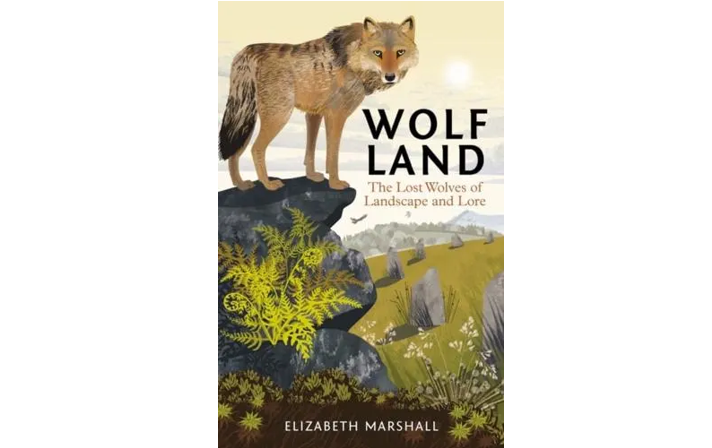
The Lost Wolves of Landscape and Lore
Elizabeth Marshall
Pelagic Publishing, 2026, 272 pages
Hardback £25.00 | ISBN 978-1-78427-396-5
Review by Barry Larking
A nephew took his very large, very black dog for a walk in the woods a few years ago. On a path Cooper, the dog, froze, looking directly ahead. Another canine had appeared crossing in front, halted and watched with a fixed gaze. It was a wolf. The stand-off lasted a few seconds. The wolf melted into the forest. Cooper did not follow.
This was near Hannover, Germany. Two winters ago three wolves passed through a neighbouring field in a blizzard. They were captured as grey shapes on a camera phone photograph. By this time wolves had also turned up in several other western European countries; one was shot in Denmark creating a public furore. The presence of wolves in parts of Western Europe from which they had been banished centuries before, was becoming real, no longer simply imaginary characters in traditional stories told to children. Old legends began to stir.
The stuff of legends is a central thread in this engaging work. Our wolf-free societies’ thoughts about the wolf, entirely vicarious, so we believed, are its substance. Even before wolves became a corporeal item in the heavily populated and domesticated landscapes of Europe’s more western edges, the legacy of wolves has never left our minds and dreams. They are seen as cunning, stealthy, wise and deadly. The ingredients for stories, theatre and visual entertainments. Wolf, wolves, wolfing, all teeth and howling, hunting … the wolf remains as a fertile legacy in places where it has not been seen in half a millennium.
‘First catch your wolf’ is one way to shape this fascinating account. Elizabeth Marshall begins by roaming like her subject, across some sweeping hinterland of document and memory, folklore and science, picking out the human story when and where it touched the wolves and vice versa. The earliest phase of this story of contact and observation, placing and description, must be conjecture. When and how did those contacts arise? Cave art is strangely devoid of images of wolves when so much else in the fauna of the hunter gatherers was illustrated with great empathy; we must come forward millennia for the wolf to step into the human gaze in pictorial terms. But surely, our ancestors’ lives must have had long contact with such an iconic hunter? Like to like?
Dr. Marshall’s impressive reading towards her study is both extensive and catholic; literary, cultural and political. She embraces almost anyone it seems who had something to say about wolves or, equally important, develop what wolves can represent, figuratively or actual, to us. For serious researchers into wolves and culture, a place to begin I suggest. The sure grasp and deployment of the mass of material is impressive and stimulating. Marshall’s expertise in medieval history and research throws up an entire trove of wolf references and incidents recorded in medieval sources of which possibly most of her readers would otherwise remain ignorant.
The penultimate chapters are a lucid discussion of how wolves might be accommodated within a western modernity that, as one of Marshall’s quoted sources says, “began when wolves disappeared”. The arguments are complex, variable and uncertain. The announced success of the US Yellowstone National Park wolf re-introduction is tantalising for enthusiasts of wolf re-introduction in certain Scottish wild land projects. But the book points to caveats that give pause to ambition. The wolf is not a tool despite its oft cited ecosystem function. In these chapters Marshall acts as if a legal advocate speaking on behalf of the wolf in the public arena – a not unimportant feature of her study as a whole.
This narrative is one of a moving, telescopic focus; past and present, back and forth; our current understanding cast back before recording was a human necessity, seeking for insights. Significantly, in the moment it enters our human history, the wolf is clearly, dramatically, already a ‘thing’ with a fully formed psychological context for the human being, already so engaged with humans that it is, for Marshall, in many significant ways a commentary on us. She examines the evidence of our current understanding of wolf fact from fiction, from the original roaming human bands to today’s defined, organising and populated nation states. The wolf jogs through our evolved land boundaries. It remains a creative force in our minds, linked to a conjoined distant wilder past. But what kind of future…?